

Non-microbial biostimulants shape secondary metabolism and nitrate accumulation in organic arugula leaves

By: Michele Ciriello1, Luana Izzo2, Abel Navarré Dopazo2, Emanuela Campana1, Giuseppe Colla3, Giandomenico Corrado1, Stefania De Pascale1, Youssef Rouphael1, Christophe El-Nakhel1

1 Department of Agricultural Sciences, University of Naples Federico II, 80055 Portici, Italy
2 Department of Pharmacy, University of Naples Federico II, 80131 Naples, Italy
3 Department of Agriculture and Forest Sciences, University of Tuscia, 01100 Viterbo, Italy

Food is no longer just about gastronomy, but a conscious and informed choice that is essential for maintaining a balance between physical and mental health. The unprecedented interest of the scientific community in vegetables with high nutraceutical impact, combined with consumers’ need for quick, easy, and healthy meals, has contributed to the economic boom of fresh-cut produce such as arugula [Eruca sativa (L.) and Diplotaxis tenuifolia (DC.)]. Long-term consumption of this leafy vegetable, thanks to the coexistence of functional secondary metabolites such as glucosinolates, flavonoids, and phenolic acids, would have a positive impact on human health. However, almost no one consumes enough to benefit from these positive effects. To address this challenge, greater consumption of leafy green vegetables could be further promoted, or efforts could be made to improve the phytochemical density and thus the nutritional quality of the product itself. In any case, since phenolic compounds and glucosinolates are actively involved in plant defense, their biosynthesis can be stimulated by abiotic and/or biotic factors or indirectly induced by the use of natural products that activate the plant’s defense mechanisms Even though using natural biostimulants can have a positive effect on plant health, most reports have focused on the benefits in terms of yield and not on the possible effects on nutritional quality. The ability to promote plant growth regardless of mineral content has made the use of biostimulants essential in organic farming. The well-established positive action of biostimulants on organic and non-organic crops must be accompanied by further studies on their role in improving nutraceutical quality.

This study aims to characterize the phytochemical properties of arugula production in an organic farming context, identifying, through UHPLC-Q-Orbitrap HRMS analysis and ion chromatography, the potential beneficial effects of three different non-microbial biostimulants. The experiment was conducted at the Piana del Sele production site (Salerno, Italy) during the winter-spring season for a total duration of 36 days. Irrigation was managed using a drip irrigation system, while normal agricultural practices permitted in organic farming were applied to manage pathogens, fungi, and insects. A completely randomized block design was used for this experiment, in which the treatments were replicated four times. Specifically, three different non-microbial biostimulants were compared with an untreated control on arugula plants (Diplotaxis tenuifolia (L.) DC.). The biostimulants used were a vegetable protein hydrolysate (hereinafter V-PH), a plant extract (hereinafter PE), and a seaweed extract (hereinafter SWE).

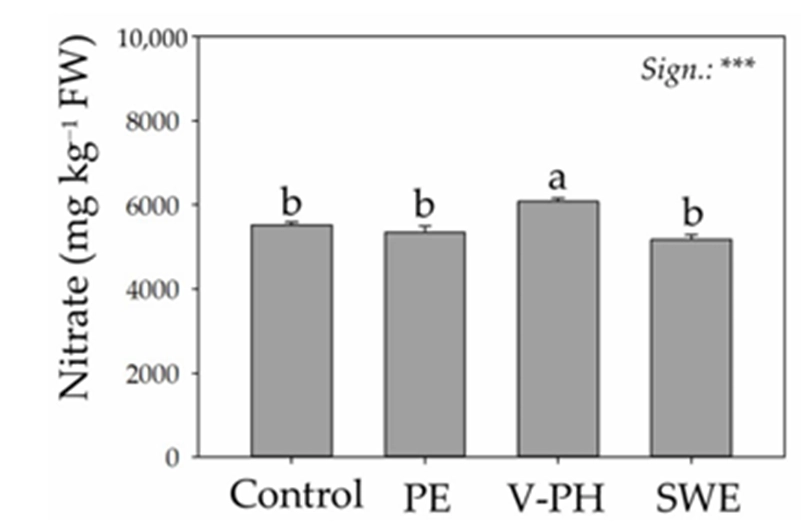
The different origins of the biostimulants tested in this experiment had a distinct influence on the nitrate content in organic arugula. While the application of products based on tropical plant extracts (PE) and seaweed extracts (SWE) did not result in significant differences compared to the nitrate values recorded in the control plants, the use of the biostimulant based on plant-derived protein hydrolysates (V-PH) resulted in a 10% increase.

Experimental plots placed on the benches

Figure x: Effect of different non-microbial biostimulants on the nitrate concentration of greenhouse grown wild arugula. Different letters indicate significant mean differences. ***: p ≤ 0.001

We hypothesize that the greater accumulation of nitrates in arugula plants treated with V-PH may be a direct consequence of a more efficient and developed root system (in terms of secondary branching and overall root biomass), which would have increased the rate of nitrate absorption and their transfer to the edible part.
glucosinate content

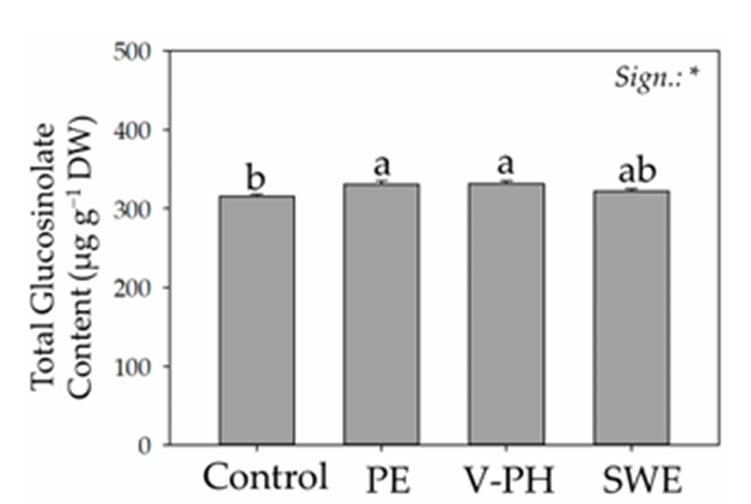
Figure x: Effect of different non-microbial biostimulants on total glucosinolate content of greenhouse grown wild arugula. Different letters indicate significant mean differences. *: p ≤ 0.05

The study on the main bioactive compounds analyzed confirms that the use of specific natural bioproducts may have triggered the activation of specific defense mechanisms attributable in part to the increase in total GLS content recorded in arugula plants treated with PE and V-PH. This mechanism may be linked to the priming action of biostimulants, which would allow the treated plant to respond more readily to abiotic stress factors through the upregulation of genes related to priming and systemic acquired resistance (SAR). In addition to the priming effect, the higher GLS values recorded in plants treated with PE and V-PH could be a direct consequence of the documented enhancement of nitrogen and carbon metabolic pathways, which would provide more usable energy for the biosynthesis of the precursors of the aforementioned bioactive compounds. A possible increase in the expression of genes directly involved in oxidative and reductive carbon metabolic processes and nitrogen metabolism would justify the involvement of metabolic pathways connected to the biosynthesis of phenolic compounds, confirming the higher levels of phenolic acids recorded in treatments with the VP-H biostimulant. In contrast, the total flavonol content was positively influenced by the application of the SWE biostimulant. The increased biosynthesis of flavonols could in this case be attributed to a significant increase in enzyme activity related to plant defense (ammonia lyase, peroxidase, phenylalanine, polyphenol oxidase, β-1,3-glucanase, and chitinase) triggered by key components present in the algae-based biostimulant.

This study demonstrates how the foliar application of specific biostimulants (vegetable protein hydrolysate, plant extract, and seaweed extract) positively influenced the biosynthesis of the main secondary metabolites found in rocket plant tissues. The results clearly show how the different origins and compositions of the products studied influence the biosynthesis of distinct metabolic classes. In particular, while the foliar application of the biostimulant obtained by enzymatic hydrolysis of vegetables improved the content of phenolic acids and glucosinolates, the application of the extract obtained from seaweed positively regulated the production of flavonoids.


REFERENCES (click)

further information can be found in these articles:

https://doi.org/10.3390/foods14142489