
土壤盐渍化正日益成为威胁全球农业生产力和粮食安全的全球性问题,严重影响土壤性质、植物生长和微生物群落。 外源性生物刺激剂的应用已成为增强植物耐盐应激能力的一种有效策略。其中,富含生物活性化合物的农业副产品(如玉米浸出液,CSL)以及肌醇(MI)等小分子信号分子,在改善植物受胁迫条件下的生长表现方面展现出令人鼓舞的效果。 CSL富含氨基酸、有机酸和促生长物质,而MI则作为渗透保护剂和信号分子,参与应激反应和离子平衡。尽管已有研究报道了它们各自的作用,但二者联合应用的潜在协同效应仍未得到充分探索。
在本研究中,我们探讨了CSL、MI及其组合对大白菜(Brassica rapa pekinensisL.)生长和耐盐性的影响。大白菜是一种在中国广泛种植的耐盐性较差的作物。研究采用完全随机设计,在盐渍化和非盐渍化条件下设置了8个处理。
研究结果表明,所有处理措施均能促进植物生长、根系发育和养分吸收,同时在盐胁迫条件下减轻氧化损伤和离子毒性。值得注意的是,联合施用(NCM)的效果最为显著,成功恢复了生物量,改善了根系形态,减少了Na⁺积累,并维持了离子稳态。此外,NCM通过降低pH值、电导率和可溶性盐含量,显著改善了土壤的物理化学性质。
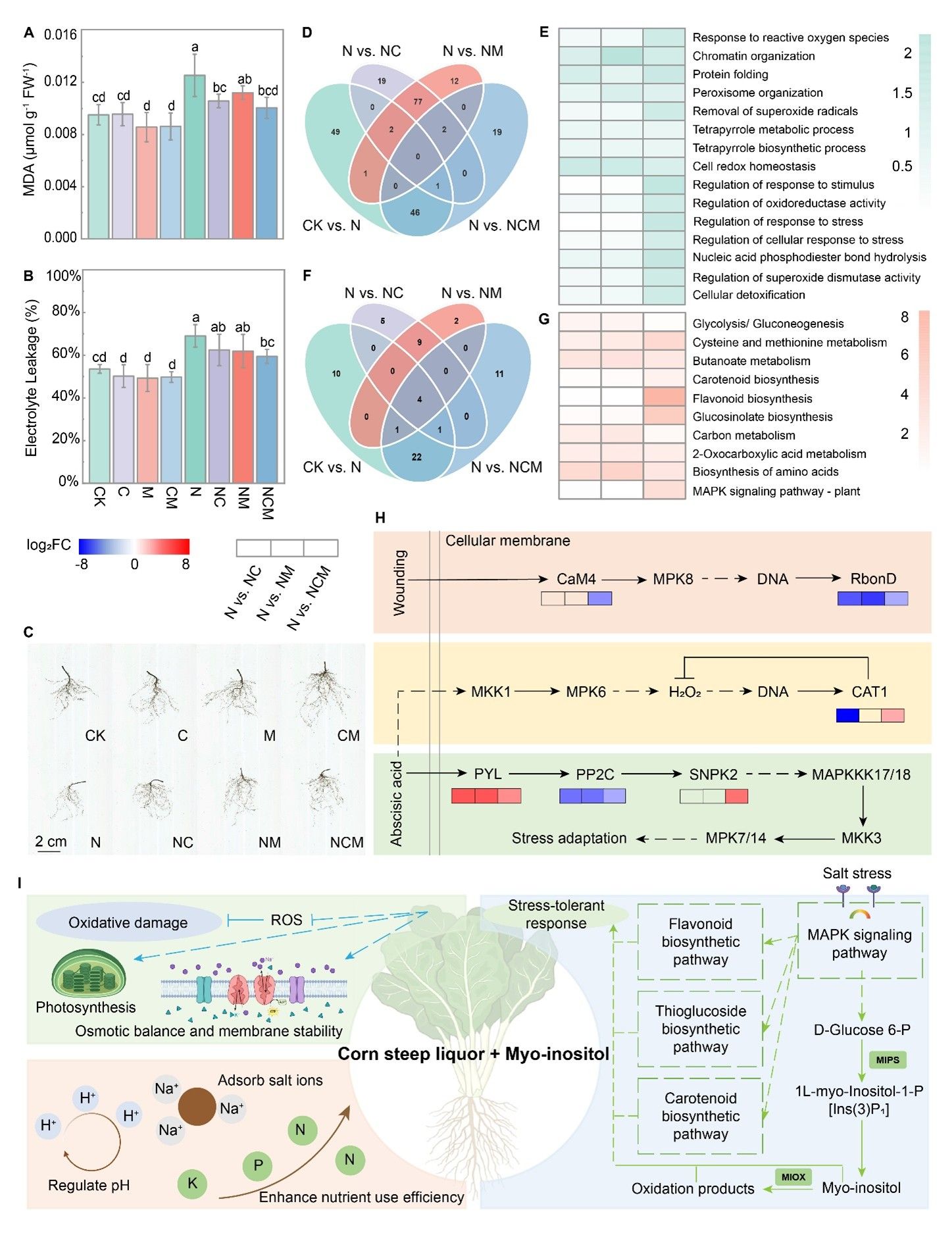
Fig. The effects of the combined application of CSL and MI on alleviating salt stress in Chinese cabbage. (A) MDA content, (B) EL, (C) root morphology, (D) and (E) Venn diagrams showing significantly enriched biological processes (BPS) and Kyoto Encyclopedia of Genes and Genomes (KEGG) pathways in the DEGs across the various comparison groups. (F) and (G) BPs and KEGG pathway enrichment analysis of DEGs in the three control groups. The color scale represents the logarithm of the P-value (P < 0.05). (H) Profile of DEGs in the MAPK signaling pathway in N vs NC, N vs NM, and N vs NCM. The color scale represents the normalized foldchange of genes expressed in NC, NM, and NCM compared to N. Significant differences among treatment groups in (A) and (B) were determined using Duncan’s multiple range test. Different letters indicate significant differences between treatment groups (P < 0.05). PYL: Pyrabactin Resistance1-Like; PP2C: Protein Phosphatase 2C; SnRK2: Sucrose Non-Fermenting 1-Related Protein Kinase 2; MPK6/7/8/14: Mitogen-Activated Protein Kinase 3/6/8; MKK1/3: Mitogen-Activated Protein Kinase Kinase 1/3; MAPKKK17/18: Mitogen-Activated Protein Kinase Kinase Kinase 17/18; CaM4: Calmodulin 4; RbohD: Respiratory Burst Oxidase Homolog D; CAT1: Catalase 1. (I) The mechanism of CSL and MI co-application in mitigating salt stress in Chinese cabbage. Arrows represent activation; T-shaped terminators represent inhibition; dashed arrows indicate indirect effects; and solid lines indicate direct effects. CK (non-saline soil + water), C (non-saline soil + CSL), M (non-saline soil + MI), CM (non-saline soil + CSL + MI), N (saline soil + water), NC (saline soil + CSL), NM (saline soil + MI), and NCM (saline soil + CSL + MI).
为了进一步阐明其潜在机制,进行了转录组分析。结果表明,联合处理重塑了基因表达谱,其中NCM与非应激对照组聚类密切,表明盐胁迫得到了有效缓解。 功能富集分析显示,差异表达基因主要参与氧化还原稳态、活性氧(ROS)响应及应激调控。此外,包括黄酮类和类胡萝卜素生物合成以及丝裂原活化蛋白激酶(MAPK)信号传导通路在内的关键代谢通路,均受到联合处理的显著调控。
从机制上讲,CSL和MI协同增强了抗氧化能力和应激信号传导。联合处理通过上调PYL和SnRK2基因并抑制PP2C的表达,激活了ABA介导的MAPK信号传导,并通过调控RbohD和CAT1等抗氧化基因来调节活性氧(ROS)的产生。 此外,参与肌醇代谢的关键基因(包括 BrMIPS1 和 BrMIOX4)的表达发生了显著改变,表明 MI 生物合成和氧化途径存在反馈调节。次生代谢的调节通过增强抗氧化能力,进一步提高了抗逆性。
总之,CSL与MI的联合应用通过调节生理过程、基因表达、离子稳态及土壤条件,有效提高了大白菜的耐盐性。所观察到的协同效应表明,这是一种极具前景、环保且经济高效的生物刺激剂策略,有助于提高作物产量并促进盐渍土的可持续利用。