

Soil salinization is an increasing global threat to agricultural productivity and food security, severely affecting soil properties, plant growth, and microbial communities. The application of exogenous biostimulants has emerged as an effective strategy to enhance plant tolerance to salt stress. Among them, agricultural byproducts rich in bioactive compounds, such as corn steep liquor (CSL), and small signaling molecules like myo-inositol (MI), have shown promising effects in improving plant performance under stress conditions. CSL is rich in amino acids, organic acids, and growth-promoting substances, while MI functions as an osmoprotectant and signaling molecule involved in stress response and ion balance. Although their individual roles have been reported, the potential synergistic effects of their combined application remain largely unexplored.
In this study, we investigated the effects of CSL, MI, and their combination on the growth and salt tolerance of Chinese cabbage (Brassica rapa pekinensis L.), a salt-sensitive crop widely cultivated in China. A completely randomized design with eight treatments under saline and non-saline conditions was employed.
Our results showed that all treatments improved plant growth, root development, and nutrient uptake, while alleviating oxidative damage and ion toxicity under salt stress. Notably, the combined application (NCM) exhibited the most significant effects, successfully restoring biomass, improving root morphology, reducing Na⁺ accumulation, and maintaining ion homeostasis. In addition, NCM markedly improved soil physicochemical properties by reducing pH, electrical conductivity, and soluble salt content.
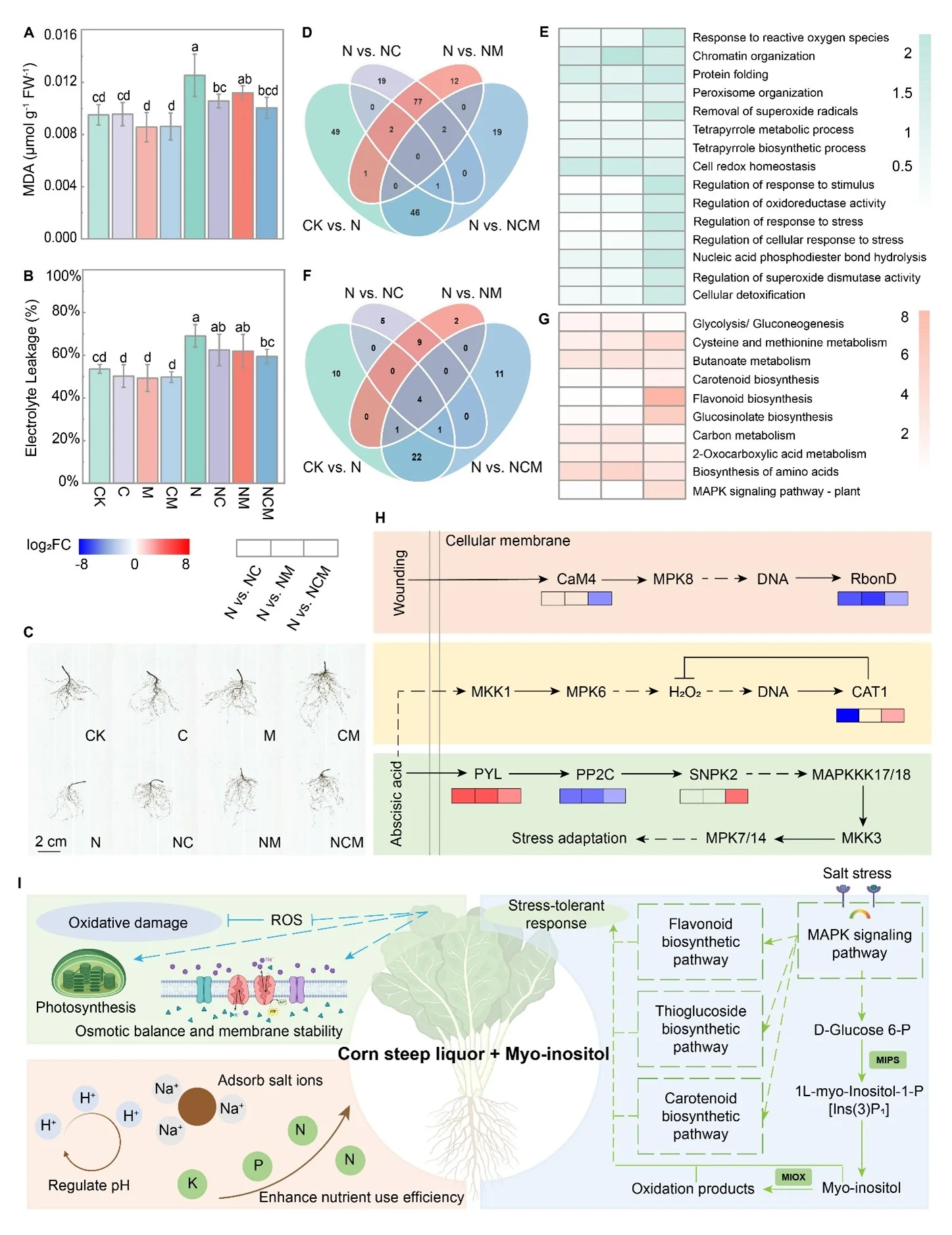
Fig. The effects of the combined application of CSL and MI on alleviating salt stress in Chinese cabbage. (A) MDA content, (B) EL, (C) root morphology, (D) and (E) Venn diagrams showing significantly enriched biological processes (BPS) and Kyoto Encyclopedia of Genes and Genomes (KEGG) pathways in the DEGs across the various comparison groups. (F) and (G) BPs and KEGG pathway enrichment analysis of DEGs in the three control groups. The color scale represents the logarithm of the P-value (P < 0.05). (H) Profile of DEGs in the MAPK signaling pathway in N vs NC, N vs NM, and N vs NCM. The color scale represents the normalized foldchange of genes expressed in NC, NM, and NCM compared to N. Significant differences among treatment groups in (A) and (B) were determined using Duncan’s multiple range test. Different letters indicate significant differences between treatment groups (P < 0.05). PYL: Pyrabactin Resistance1-Like; PP2C: Protein Phosphatase 2C; SnRK2: Sucrose Non-Fermenting 1-Related Protein Kinase 2; MPK6/7/8/14: Mitogen-Activated Protein Kinase 3/6/8; MKK1/3: Mitogen-Activated Protein Kinase Kinase 1/3; MAPKKK17/18: Mitogen-Activated Protein Kinase Kinase Kinase 17/18; CaM4: Calmodulin 4; RbohD: Respiratory Burst Oxidase Homolog D; CAT1: Catalase 1. (I) The mechanism of CSL and MI co-application in mitigating salt stress in Chinese cabbage. Arrows represent activation; T-shaped terminators represent inhibition; dashed arrows indicate indirect effects; and solid lines indicate direct effects. CK (non-saline soil + water), C (non-saline soil + CSL), M (non-saline soil + MI), CM (non-saline soil + CSL + MI), N (saline soil + water), NC (saline soil + CSL), NM (saline soil + MI), and NCM (saline soil + CSL + MI).
To further elucidate the underlying mechanisms, transcriptome analysis was conducted. The results indicated that the combined treatment reshaped gene expression profiles, with NCM clustering closely with the non-stress control, suggesting effective mitigation of salt stress. Functional enrichment analyses revealed that differentially expressed genes were mainly involved in redox homeostasis, reactive oxygen species (ROS) response, and stress regulation. Moreover, key metabolic pathways, including flavonoid and carotenoid biosynthesis as well as the mitogen-activated protein kinase (MAPK) signaling pathway, were significantly regulated by the combined treatment.
Mechanistically, CSL and MI synergistically enhanced antioxidant capacity and stress signaling. The combined treatment activated ABA-mediated MAPK signaling by upregulating PYL and SnRK2 genes while suppressing PP2C expression, and modulated ROS production through the regulation of RbohD and antioxidant genes such as CAT1. Additionally, the expression of key genes involved in inositol metabolism, including BrMIPS1 and BrMIOX4, was significantly altered, indicating feedback regulation of MI biosynthesis and oxidation pathways. The modulation of secondary metabolism further contributed to enhanced stress tolerance through increased antioxidant capacity.
In conclusion, the combined application of CSL and MI effectively enhances salt tolerance in Chinese cabbage by regulating physiological processes, gene expression, ion homeostasis, and soil conditions. The observed synergistic effects highlight a promising, eco-friendly, and cost-effective biostimulant strategy for improving crop performance and promoting the sustainable utilization of saline soils.


© BIOSTIMULANT.COM
ALL RIGHTS RESERVED