

“Biologicals” has become one of the most frequently used terms in agriculture. But what exactly does it mean? Are biologicals and biostimulants the same thing? The answer is no. Understanding the distinction is important for farmers, distributors and anyone interested in sustainable crop production.
Biologicals: An umbrella term
The word biologicals is widely used across the agricultural sector to describe products derived from natural sources, such as microorganisms, plant extracts, algae, proteins or other naturally occurring substances, that support crop production.
However, there is one important point:
“Biologicals” is not a legally defined product category in most regulations.
Instead, it is an umbrella term commonly used by the industry to describe several groups of products that fall under different regulatory frameworks.
Some biologicals are intended to improve plant nutrition, while others protect crops against pests and diseases.
Two major families of agricultural inputs
Agricultural inputs can broadly be divided into two regulatory families.

- Fertilizing Products
These products primarily aim to provide nutrients or improve nutrient use by plants and soils.
They include:
- Mineral fertilizers
- Organic fertilizers
- Organo-mineral fertilizers
- Liming materials
- Growing media
- Soil improvers
- Plant biostimulants
These products are regulated in Europe under Regulation (EU) 2019/1009.
- Plant Protection Products
These products are designed to protect crops from harmful organisms such as insects, fungi or weeds.
They include:
- Insecticides
- Fungicides
- Herbicides
- Molluscicides
- Plant growth regulators
- Basic substances
- Biopesticides
These products are regulated in Europe under Regulation (EC) No 1107/2009.
Although some of these products are biological in origin, their purpose is crop protection rather than plant nutrition or stimulation.
Where do biostimulants fit?
Plant biostimulants belong to the fertilizing products family.
Unlike fertilizers, they are not intended to supply significant amounts of nutrients.
Instead, they stimulate the plant’s natural processes, improving characteristics such as:
- nutrient use efficiency
- tolerance to abiotic stress
- nutrient availability in the soil or rhizosphere
- crop quality
Plant biostimulants are officially recognized and regulated under the European Fertilizing Products Regulation.
Microbial and non-microbial biostimulants
Plant biostimulants can be divided into two broad categories.
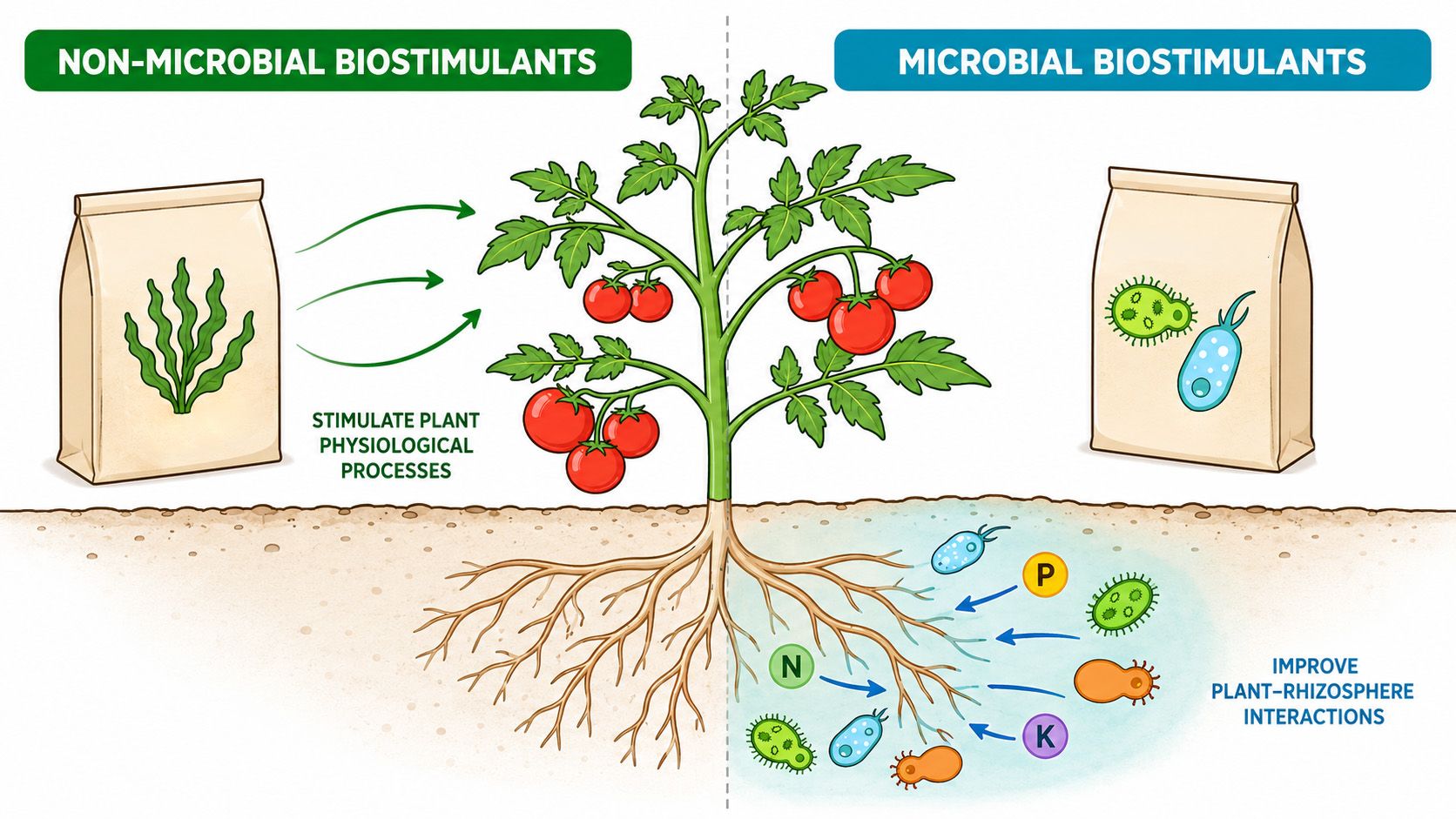
Non-microbial biostimulants
These contain substances such as:
- protein hydrolysates
- seaweed extracts
- humic and fulvic substances
- silicon
- other naturally derived compounds
They act by stimulating the plant’s own physiological processes.
Microbial biostimulants
These contain beneficial microorganisms, such as selected bacteria or fungi.
Rather than acting directly on the plant, they improve interactions within the rhizosphere, helping plants access nutrients and better cope with environmental stresses.
What about biofertilizers?
The term biofertilizer is widely used around the world but has no harmonized legal definition.
Depending on the country, it may refer to:
- microbial inoculants,
- microbial biostimulants,
- products that improve nutrient availability,
or other biological formulations.
For this reason, it is important to understand how a product is regulated in each market rather than relying solely on the term “biofertilizer.”
Where do bio-based fertilizers fit?
Bio-based fertilizers are fertilizers whose nutrients originate wholly or partly from biological, renewable or recycled raw materials rather than synthetic mineral sources.
Examples include:
- Organic fertilizers
- Organo-mineral fertilizers
- Certain recycled nutrient products
Like conventional fertilizers, their primary role is to supply nutrients to crops. Their difference lies in the origin of the raw materials rather than in their agronomic function.
For this reason, bio-based fertilizers belong to the fertilizing products category, alongside mineral fertilizers, soil improvers and plant biostimulants.
Although they are often grouped under the broader concept of “biologicals” because of their natural origin, they should not be confused with plant biostimulants, which have a different mode of action and a different regulatory definition.
Biopesticides: another type of biological
Biopesticides are often grouped under the broader concept of biologicals because they originate from natural organisms or substances.
They include products based on:
- microorganisms,
- natural substances,
- semiochemicals,
whose purpose is to prevent or control pests and diseases.
Unlike biostimulants, their primary function is plant protection, not the stimulation of plant physiology.
Why is the distinction important?
Because products may share a natural origin while serving completely different purposes.
A seaweed extract that stimulates plant growth, a beneficial bacterium that improves nutrient uptake, and a microbial product that controls a fungal disease may all be described as “biologicals,” yet they belong to different regulatory categories and have different modes of action.
Understanding these distinctions helps farmers choose the right solution for the right objective and promotes a clearer understanding of the rapidly evolving biological inputs sector.



© BIOSTIMULANT.COM
ALL RIGHTS RESERVED