

The global market for ready-to-eat leafy green vegetables has grown fast, driven by consumer demand for fresh, convenient, and healthy foods. However, certain aspects of the production chain for this type of product are crucial to food safety.
Microbial contamination represents a major concern, as fresh-cut vegetables have been increasingly associated with outbreaks of foodborne illnesses caused by pathogens such as Escherichia coli. This pathogen can survive and grow on leafy vegetables like lettuce and may reach the edible parts through organic fertilizers, irrigation and processing water, or contaminated surfaces along the production chain.
Agronomic practices can influence microbial population dynamics in plant tissues. Plant biostimulants, for example, are increasingly being used to improve crop performance, nutrient use efficiency, stress tolerance, and quality traits. Seaweed extracts from Ascophyllum nodosum, as well as vegetal-derived protein hydrolysates, are among the most frequently used biostimulants in vegetable crops.
Previous research has demonstrated that foliar application of biostimulants can modify the microbial community structure, activating beneficial epiphytic microorganisms with plant-growth-promoting and biocontrol properties. However, the effects of these biostimulants on human pathogenic bacteria such as E. coli are still poorly understood. Given that plant biostimulants can be sprayed multiple times on leafy crops, even shortly before harvest, it is important to understand how they can affect E. coli population dynamics in lettuce leaves to guarantee food safety.
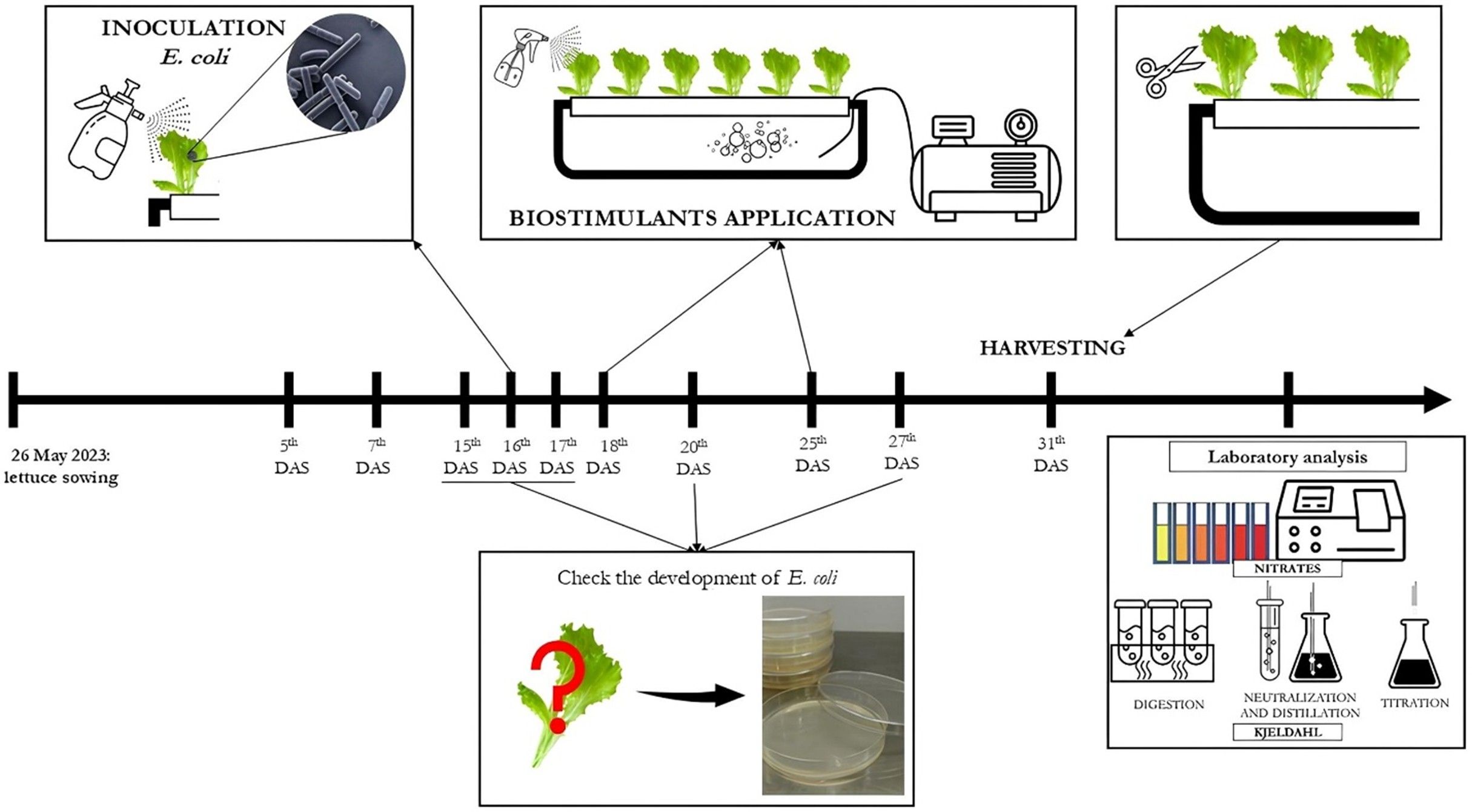
Fig. 1. Timeline of treatment application, E. coli inoculation and analysis in the agronomic trial
The study was structured into two distinct experiments. The first in vitro experiment assessed the direct effect of two plant biostimulants – an Ascophyllum nodosum seaweed extract (SWE) and a legume-derived protein hydrolysate (PH) – on a non-pathogenic strain of E. coli (K12) growth in liquid culture. The second experiment was an agronomic study in which lettuce plants were grown in a floating system and treated with E. coli K12. Biostimulants were applied as foliar sprays, and the survival of E. coli on leaf surfaces, the total aerobic bacterial population, and plant growth and nitrogen-related parameters (total nitrogen and nitrate concentration) were monitored. Figure 1 shows the different step about agronomic trial, from sowing to harvest.

Table. 1. Effects of biostimulant treatments on lettuce biomass and nitrate and total nitrogen concentration in lettuce leaves
In vitro assays revealed that neither SWE nor PH had a significant influence on E. coli K12 growth, indicating the absence of a direct inhibitory or stimulating effect. In the greenhouse experiment, biostimulant treatments had no significant effect on lettuce biomass production, leaf nitrogen and nitrate concentrations (Table 1).
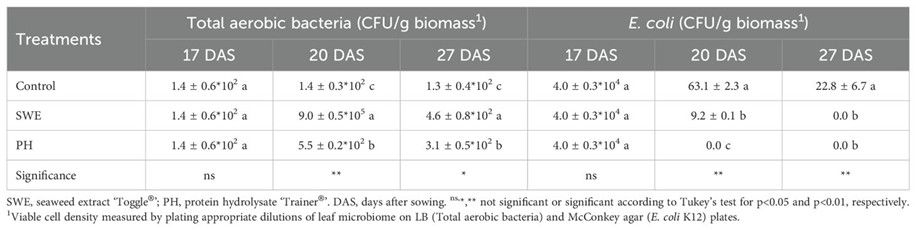
Table. 2. Effects of biostimulant treatments on the total epiphytic aerobic bacteria and E. coli population of lettuce leaves
However, clear differences emerged at the phyllosphere level, where biostimulant treatments significantly altered microbial population dynamics (Table 2). While untreated plants showed no substantial variations in total aerobic bacteria, both biostimulants significantly boosted aerobic bacterial abundance, with the seaweed extract having the greatest effect. Furthermore, although E. coli populations decreased over time across all treatments, the reduction was faster and more pronounced in biostimulant-treated plants, particularly with the protein hydrolysate, whereas E. coli was detectable in untreated plants until the end of the trial.
This study revealed that plant biostimulants, while increasing the growth of plant-associated aerobic bacteria, also reduced E. coli viability in lettuce leaves, indicating that they could be used as a valuable and sustainable strategy to improve the microbiological quality of leafy greens for ready-to-eat foods.


©2020 BIOSTIMULANT.COM
ALL RIGHTS RESERVED